

For Brazilian companies that used this solution to issue and receive electronic tax documents, the impact is not gradual. It is immediate. Any changes published by SEFAZ or the Federal Revenue Service after that date will simply not be reflected in the system. And in the context of the Tax Reform, which officially took effect in January 2026, these changes are not only coming—they are already here.
This article explains what has changed, the specific risks of continuing to operate with GRC in 2026, and the options available to companies running SAP, whether or not they migrate to S/4HANA.
What was SAP GRC NF-e and why was it discontinued?
SAP GRC (Governance, Risk & Compliance) for NF-e was the module responsible for issuing and receiving electronic invoices within the SAP ecosystem in Brazil. For many years, it was the standard solution for large companies that needed to integrate their tax processes—both outbound (issuance of NF-e, CT-e) and inbound (receipt and validation of documents)—directly into the ERP.
SAP announced the discontinuation in advance, and there is a clear strategic reason for it: the company has decided to consolidate its global tax compliance solutions around SAP Document and Reporting Compliance (DRC), a platform designed for S/4HANA that addresses tax obligations in multiple countries through a standardized interface.
The problem is that this transition assumes that all companies have migrated to S/4HANA, which is far from the case in Brazil.
What has changed in practice as of January 2026
When SAP ends support for a product, this means three concrete and irreversible things:
- No layout or schema updates: SEFAZ periodically publishes changes to the XML schemas for NF-e, CT-e, and other tax documents. Any new layout version published after December 2025 will not be incorporated into GRC. If the invoice issued by your system is in an outdated format, it may be rejected during transmission.
- No bug fixes: Known bugs, as well as any that arise, will remain unresolved indefinitely. SAP will not fix them. If the system experiences processing errors, the internal team will need to work around them manually or simply live with them.
- No SAP technical support: Open support tickets for GRC will not be addressed. Critical release-related incidents that previously had resolution SLAs must now be resolved without support from the platform provider.
The specific fiscal risks in 2026
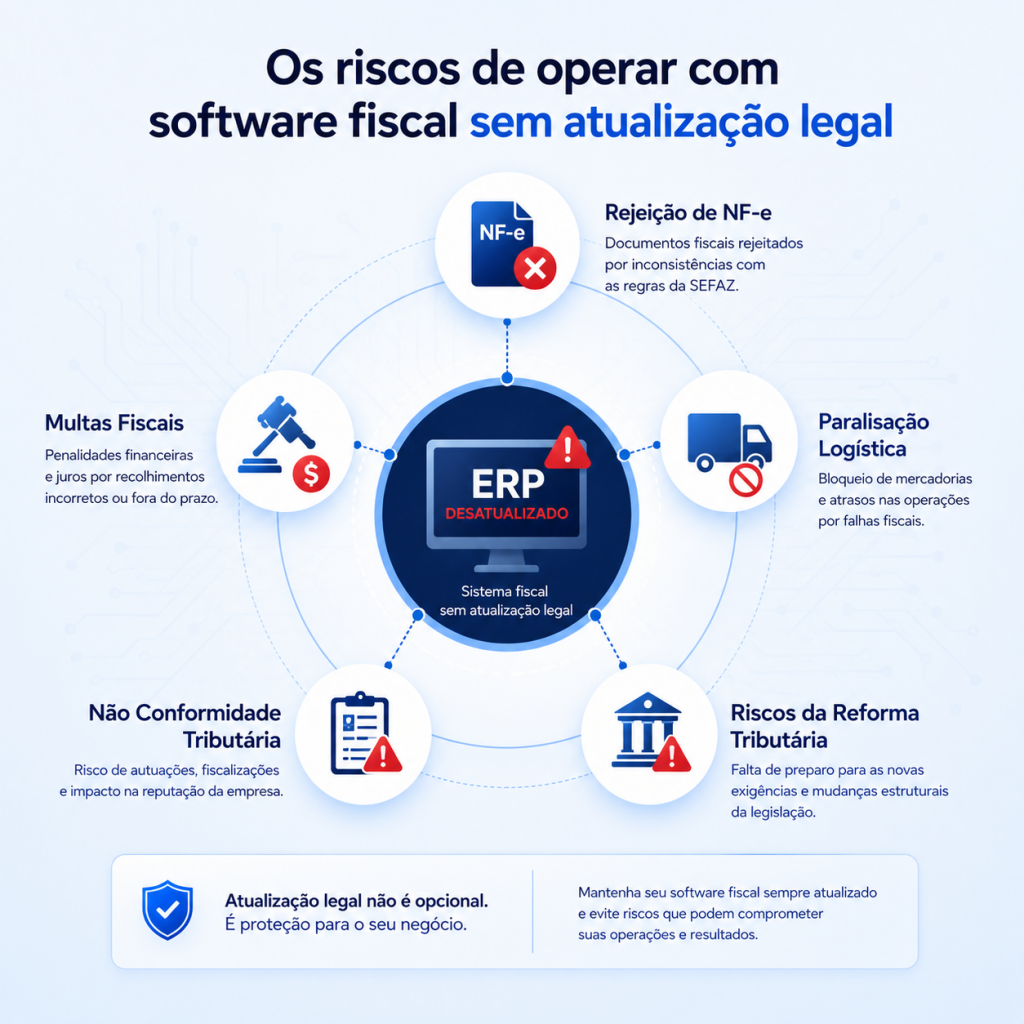
Operating with unsupported GRC in 2026 is not just a technical risk. It is a fiscal risk with measurable consequences.
Rejection of NF-e by SEFAZ
When SEFAZ updates its validation rules—which happens frequently, especially during tax reform—outdated systems begin issuing invoices with incorrect fields, wrong tax regime codes, or outdated schemas. The result is rejection during transmission, which means the process is halted: without an authorized invoice, there is no delivery, and no revenue is recognized.
Tax assessments and fines issued by the Federal Revenue Service
The Tax Reform introduces new reporting obligations and new requirements regarding the content of tax documents. A company that issues electronic invoices (NF-e) containing information that does not comply with current legislation is liable to fines, even if the non-compliance results from a system error rather than an intentional decision.
The taxpayer, not the software provider, is responsible for tax compliance.
Impact on Tax Reform
2026 marks the beginning of one of the most significant tax reforms in Brazilian history. The IBS, CBS, and selective tax are beginning to appear on tax documents, and the technical specifications will change over the next few years. A company that still relies on a system that has not been updated to comply with the law is starting this journey at a structural disadvantage.
The available options and their real trade-offs
Given this situation, companies that still use SAP GRC essentially have three options. It is important to understand the trade-offs of each before making a decision.
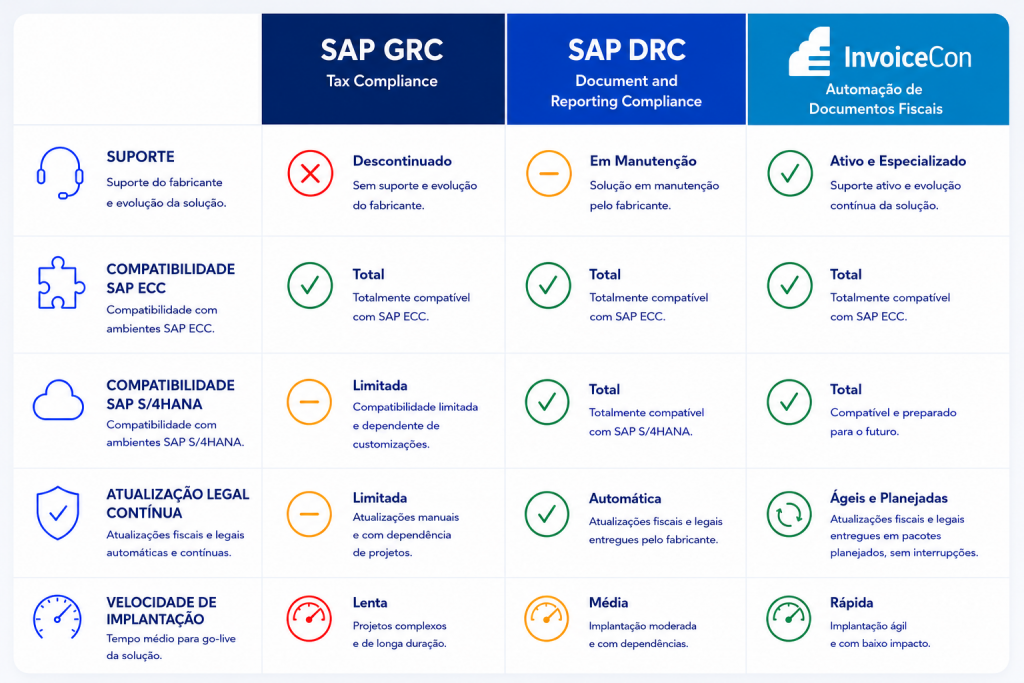
1. Migrate to SAP DRC (SAP’s official migration path)
SAP Document and Reporting Compliance is the official solution that SAP developed as the successor to GRC. It offers a standardized interface for tax compliance requirements in multiple countries, including Brazil, and is available on SAP S/4HANA.
The problem: DRC was built on S/4HANA. For companies that still run SAP ECC—which includes most large Brazilian companies with legacy SAP environments—implementing DRC requires a complete platform migration. This is a 12- to 18-month project that involves significant investment in infrastructure, licenses, and consulting services.
That doesn’t mean the DRC is the wrong path. It’s probably the right path in the medium and long term. The problem is the gap between the immediate fiscal risk that exists today and the time needed for this transition.
When it makes sense: For companies that have already planned and budgeted for their migration to S/4HANA, DRC is the natural next step. But the migration process still takes months, and tax risks won’t wait.
2. Adopt third-party middleware
Some companies choose to create an intermediate layer between SAP and a third-party tax engine: a “connector” solution that intercepts data from the ERP before transmitting it to SEFAZ.
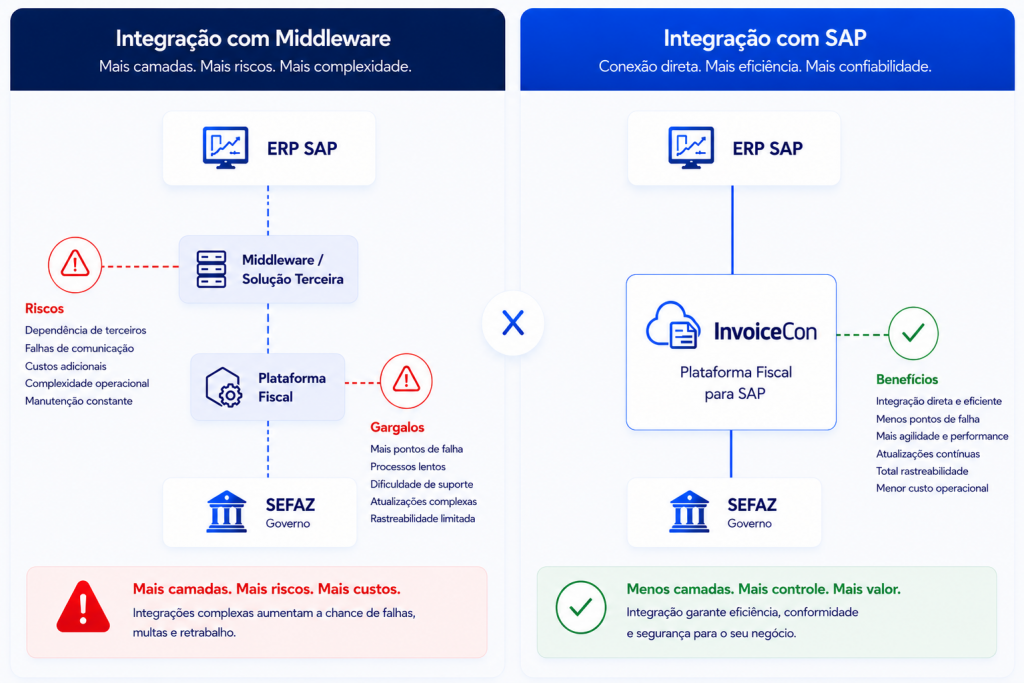
The problem: this architecture creates extra dependencies. There is an additional point of failure between SAP and SEFAZ, one more vendor to manage, and an additional support contract. During peak issuance periods, such as month-end or tax filing deadlines, any bottleneck in this intermediate layer impacts the entire operation.
Furthermore, generic middleware does not always cover all types of tax documents (NF-e, CT-e, NFS-e, NFC-e) with the level of detail required for complex SAP environments.
When it makes sense: as a very short-term emergency solution while a native integration is being implemented. Not as a permanent strategy.
3. Integration with SAP
The third option is to replace GRC with a solution that integrates with SAP and does not require a platform migration. This means:
- Compatibility with SAP ECC and S/4HANA
- Comprehensive coverage of Brazilian tax documents (NF-e, CT-e, NFS-e, NFC-e), both inbound and outbound
- Ongoing legal updates in accordance with publications from SEFAZ and the Federal Revenue Service
- Go-live in weeks, not months
That is exactly InvoiceCon's position.
How InvoiceCon serves as a replacement for GRC
InvoiceCon was developed specifically for the Brazilian tax market and uses advanced technologies to simplify the entry of tax documents.
Document coverage
- NF-e (Form 55): issuance and receipt, including event handling (cancellation, correction notice, EPEC).
- CT-e (Form 57): electronic bill of lading, inbound and outbound.
- NFS-e: electronic service invoice with nationwide coverage.
- NFS-e: electronic invoice via the InvoiceCon Outbound module.
- NFCom (Form 62): an electronic invoice specifically designed for communication and telecommunications services, which replaces previous forms and has legal validity in digital form, supported by the InvoiceCon Outbound module.
SAP Integration
The integration takes place directly within SAP’s business layers, with no additional layers between the ERP and SEFAZ. This preserves the integrity of tax data and eliminates the synchronization risks that arise in middleware architectures.
Ongoing legal updates
Cast maintains a team of experts in Brazilian tax law who monitor publications from SEFAZ, the Federal Revenue Service, and local governments. Every change is incorporated into InvoiceCon and made available to clients—without the need for clients to undertake any update projects.
Compliance with Tax Reform
InvoiceCon already incorporates the initial technical specifications of the Tax Reform. Updates planned for the coming years will be incorporated on an ongoing basis, with no impact on operations.
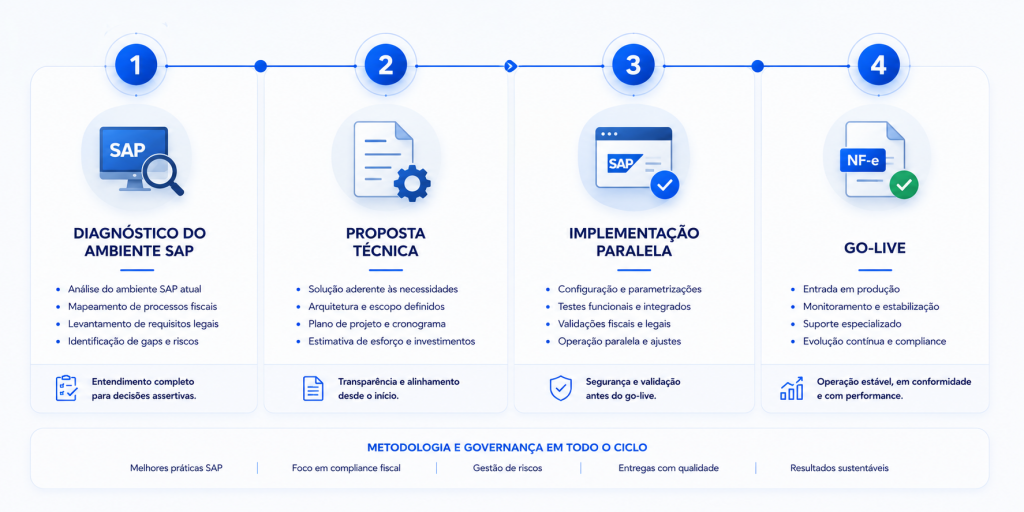
How does the migration from GRC to InvoiceCon work?
One of the main concerns for companies that need to switch GRC systems is the risk of interruptions in invoice issuance during the transition. The migration to InvoiceCon follows a structured process that minimizes this risk:
Step 1: SAP Environment Assessment – The first step is to map the current SAP environment: ECC or S/4HANA version, volume of tax documents, types of invoices used, and existing integrations with other systems. This assessment serves as the basis for defining the scope of the implementation.
Step 2: Technical and Commercial Proposal – Based on the assessment, Cast presents a detailed scope of work, implementation timeline, and commercial proposal.
Step 3: Parallel Implementation – InvoiceCon is implemented in a staging environment alongside the GRC system, without interrupting invoice issuance. The migration to production occurs only once all tax documents are being processed correctly in the new system.
Step 4: Go-live and Support – The go-live in standard environments takes place within the timeframe specified in the proposal and a few weeks after the project begins. The Cast team remains available to provide technical and operational support after the system goes live.
What to consider when evaluating any alternative to GRC
Regardless of the solution chosen, there are five criteria that every SAP company should use to evaluate alternatives to GRC:
- Integration with SAP or reliance on middleware? Middleware adds complexity. Integration does not.
- Do you have all the necessary tax documents covered? The NF-e is the bare minimum. The CT-e, NFS-e, and NFC-e must also be covered, depending on your business model.
- How does the legal update work? Does it require an internal proposal? Is it automatic? How often does it happen?
- What is the status of the tax reform? Is it just a promise of a roadmap, or has it already been implemented?
- What is the actual go-live timeline? Optimistic implementation estimates are common. Ask for references from similar projects.
Inbound: The Other Half of GRC That No One Is Talking About
When companies consider replacing their GRC system, their immediate focus is on issuing sales invoices (NF-e), transport invoices (CT-e), and service invoices (NFS-e). However, the GRC NF-e system also managed the incoming flow: the receipt, validation, and processing of invoices issued by suppliers.
This part of the process tends to be even more labor-intensive than the outbound side. An average company receives hundreds of NF-e invoices from suppliers each month, and each one must be validated, reconciled with the purchase order, and posted in SAP, generating MIGO (goods receipt) and MIRO (invoice posting) transactions.
Without automation, this process is manual, slow, and prone to errors. With GRC, there was integration. Without GRC and without a replacement, we’re back to using spreadsheets.
The InvoiceCon input module solves exactly this problem:
- Automatic download of SEFAZ XML files: no user action required, no manual import
- Artificial Intelligence-Based NFS-e Processing: Automatic Reading and Classification of Service Notes
- Document validation prior to receipt: errors identified before the truck arrives
- Automating the creation of MIGO and MIRO in SAP — accounting and tax postings are generated automatically
For companies with high purchase volumes, inbound logistics is often the biggest operational benefit of the migration. It’s not just an added feature—it’s a strategic move that saves time and boosts productivity.
Beyond the tax return: comprehensive tax compliance under the Tax Reform
Replacing the GRC resolves the issue of document issuance. However, the Tax Reform introduces broader obligations that require simultaneous attention.
The native SAP TDF covers only 15% of Brazilian tax obligations and has also been discontinued. This means that even companies with a replaced GRC system and up-to-date NF-e issuance still need to address the compliance gap regarding federal, state, and municipal obligations: SPED with the new fields from the Tax Reform, calculation of CBS and IBS during the coexistence period, credit control under transitional rules, and ongoing compliance with Federal Revenue Service publications.
For companies that use SAP and require comprehensive coverage beyond tax documents, Soficom complements InvoiceCon by covering 100% of these obligations directly within SAP, using the same native integration logic and continuous legal updates.
It is not necessary to solve both problems at the same time. But it is important to know that they exist and that they can be solved within the same ecosystem.
Conclusion: The risk of waiting
Every week that goes by without support for the GRC is a week during which SEFAZ could publish a change that the system won’t be able to keep up with. It’s not a question of “if,” but of “when” this will cause an operational or tax-related problem.
The good news is that replacing GRC doesn’t have to be a lengthy and risky project. With the right approach, you can have a native SAP solution up and running without disrupting operations and with compliance guaranteed from day one.
Next steps

If your company still uses SAP GRC NF-e or is evaluating alternatives, Cast can be your partner, helping you understand your current tax exposure and providing a clear path forward.
Request an assessment from our experts by clicking here.
This post was updated in June 2026. The information regarding the discontinuation of SAP GRC NF-e was based on SAP’s official announcement regarding the end of support on December 31, 2025.