
If your company uses SAP, you’ve certainly heard about the Tax Reform and the impacts it will have on the software. But do you know exactly what’s changing in the system starting in August? You’re not alone. Most tax and IT teams still treat 2026 as “the trial year.” And it is! But there’s a specific date coming up that’s a game-changer.
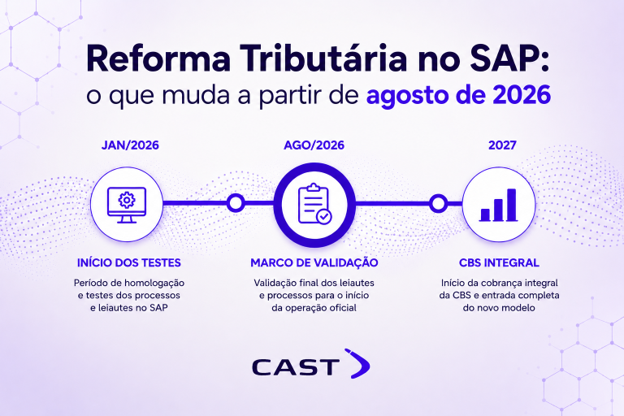
On April 30, 2026, the Federal Revenue Service and the IBS Management Committee published the regulations that finalize the initial framework for the CBS and the IBS: Decree No. 12,955/2026, CGIBS Resolution No. 6/2026, and Joint MF/CGIBS Ordinance No. 7/2026. Together, they establish August 1, 2026 as the effective date for specific provisions related to the IBS and CBS fields in electronic tax documents and for compliance with ancillary obligations for the year.
In practice: the adjustment deadline, which seemed far off, is now approaching in the middle of the third quarter.
What has been in effect since January
As of January 1, 2026, companies that issue electronic tax documents must itemize the CBS and IBS separately for each transaction, using nominal rates of 0.9% and 0.1%. These amounts are for informational purposes only; they are not included in the total amount of the invoice and are intended to test the issuance infrastructure prior to actual collection, which begins in 2027.
This testing phase covers a wide range of documents: NF-e, NFC-e, NFS-e, CT-e, CT-e OS, BP-e, MDF-e, NF3e, and NFCom. If your company uses SAP, some of these document types pass through your billing system every day.
What's Changing in August
The August deadline does not create a new tax. It marks the end of a phase in the regulatory process and narrows the margin of tolerance for inconsistencies in filling out the CBS and IBS fields. Until then, this period serves as an adjustment phase, with data validation and course corrections allowed without major penalties. After that, the bar is raised.
For SAP users, this has three direct implications:
Stricter validation of electronic documents
SAP has already published notes providing guidance on treating CBS and IBS as statistical values on invoices, applicable to S/4HANA and SAP Document and Reporting Compliance (DRC) environments. Companies that have not yet implemented these Nguidelines run the risk of rejection or data inconsistencies starting in August.
Pressure on those who still rely on the GRC NF-e
SAP discontinued support for this platform in December 2025. Those who continue to use it will lose the technical foundation needed to keep up with the upcoming layout updates required by the Reform—a problem that will only grow from this point forward. Find out what options are available for your company now.
Greater emphasis on collaboration between tax and IT teams
The changes aren’t limited to the system configuration. They involve bookkeeping, cross-checking data between EFD blocks, and correctly interpreting the technical notes published throughout the year. Anyone who treats this as a task exclusively for IT will find themselves with gaps in their records by August.
Why Planning Ahead Makes a Difference
The tax reform plan is intentionally gradual: the government wants to avoid sudden shocks to both businesses and the public coffers. But gradual does not mean slow. Between 2026 and 2033, the timeline includes technical milestones—such as the one in August—every few months, and each one requires system adjustments, testing, and validation.
Companies that treat these milestones as isolated checkpoints end up scrambling to meet deadlines. Those who organize an internal compliance schedule, mapping out which SAP Notes to apply, which fields to review, and which teams to involve, will have the work ready by each deadline—not at the last minute.
How does SOFICOM fit into this picture?
SOFICOM has been tracking updates to the Tax Reform in collaboration with SAP since the beginning of the process, with native integration into SAP and preparations for the next phases of the IBS and CBS. For companies already using SOFICOM, each regulatory milestone is implemented as a system update, and, in some cases, involves small projects to ensure compliance tonew requirements introduced by the Tax Reform—for example, debit notes and credit.
If your company hasn't yet identified what needs to be adjusted by August, now is the time to do so. CAST’s SAP-certified tax solution is based on industry best practices to bring efficiency, compliance, and continuous innovation to your company.
Talk to our team and learn how SOFICOM is the ideal complementary tax solution for your needs in the SAP environment.