
A sales representative closes a sale in the field, jots down the order in a notebook, and plans to enter it into the system later. The next day, the inventory has already changed, the price list has been updated, and the order is rejected due to an error. The customer waits. A competitor gets in touch first.
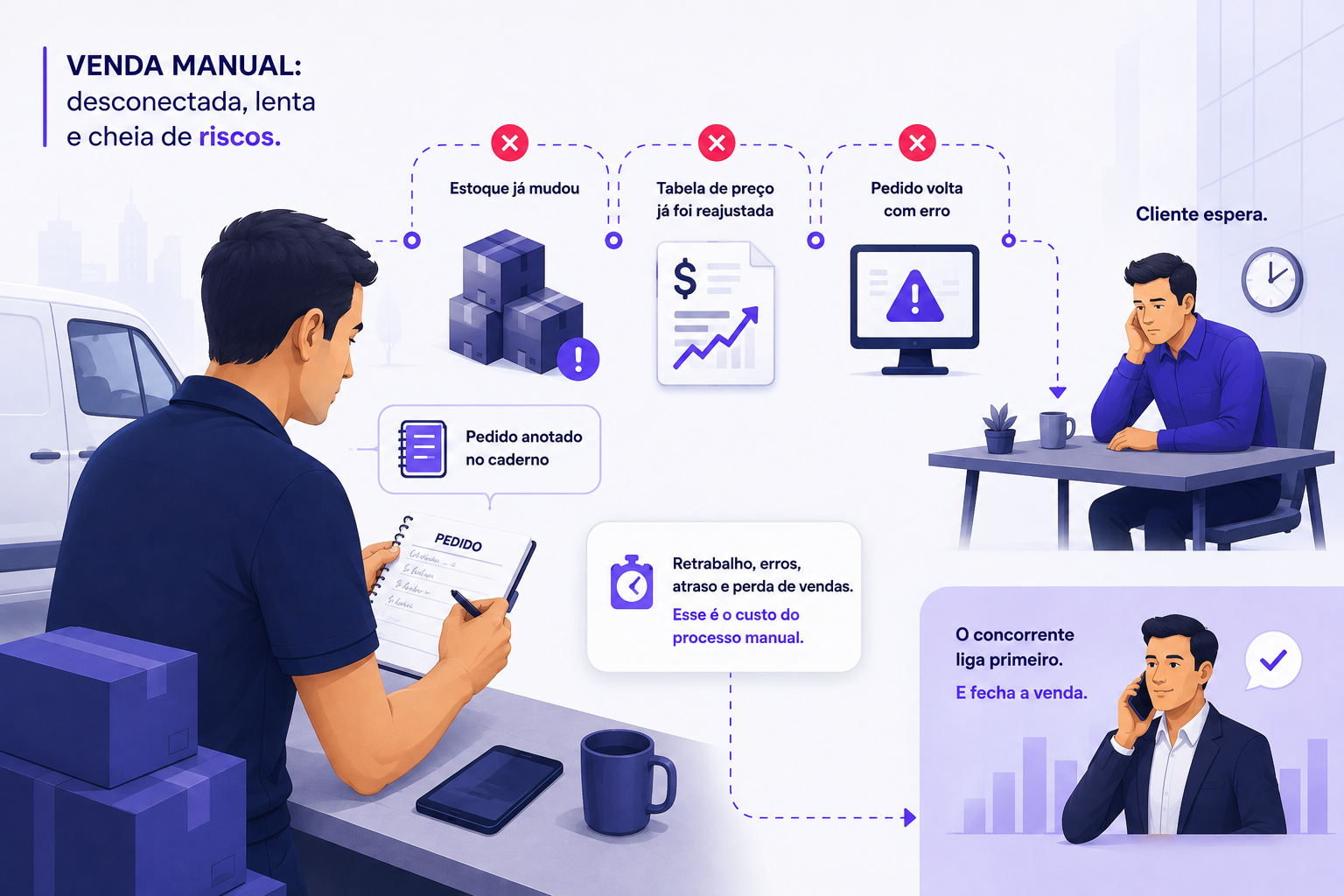
This scenario plays out in thousands of companies every day. And the reason is rarely a lack of effort on the part of the sales team, but rather the absence of a process that links what happens in the field to the information recorded in the system.
That is exactly the challenge that a Salesforce Automation solution addresses.
What Is SFA, in Practice?
SFA stands for Sales Force Automation. The term describes the set of tools that moves the sales process away from paper, spreadsheets, and the salesperson’s memory, integrating everything into a single workflow: order creation, customer inquiries, sales policies, inventory, and billing all communicate with one another.
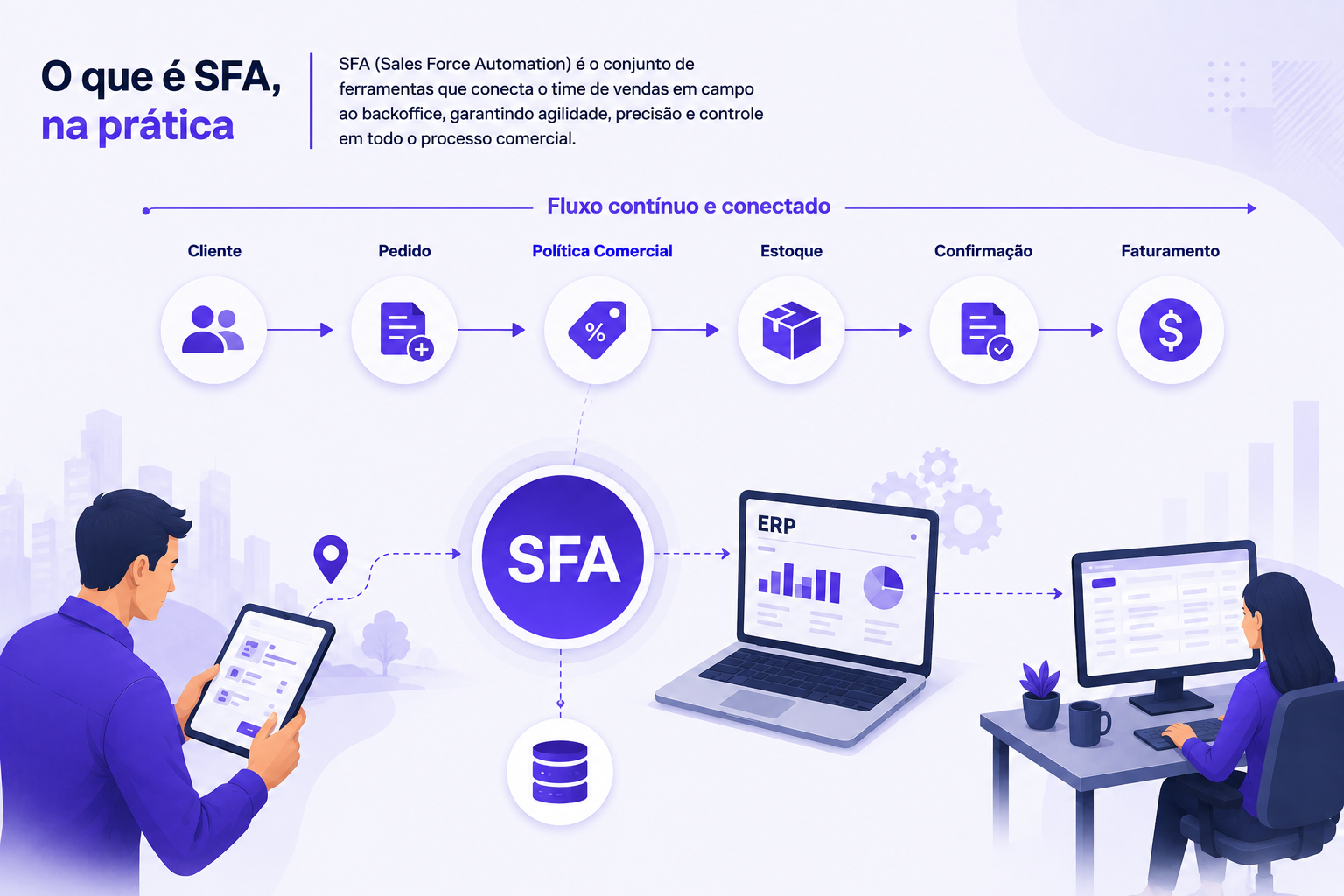
In practice, an SFA system allows the sales representative to:
- Create orders directly from your cell phone, tablet, or laptop, using the same interface on any device;
- Review the customer's complete history before negotiating (previous purchases, open orders, and terms already applied);
- Work even without an internet connection, and sync everything once the connection is restored;
- Apply the current price list and discount policy without relying on an outdated PDF.
On the back-office side, SFA eliminates the need for re-entering data. Orders created in the field arrive ready to be invoiced, without having to go through another person who would have to transcribe data from a notebook or a WhatsApp message.
Orders placed in the field are ready for billing right away, without having to rely on anyone to transcribe data from a notebook or a WhatsApp conversation.
SFA is not the same as CRM
It’s common to confuse the two, but they address different issues. CRM organizes customer relationships: contact history, sales pipeline, sales forecasts. SFA, on the other hand, automates order fulfillment in the field—that moment when the sales representative is face-to-face with the customer and needs to close, record, and confirm the sale.
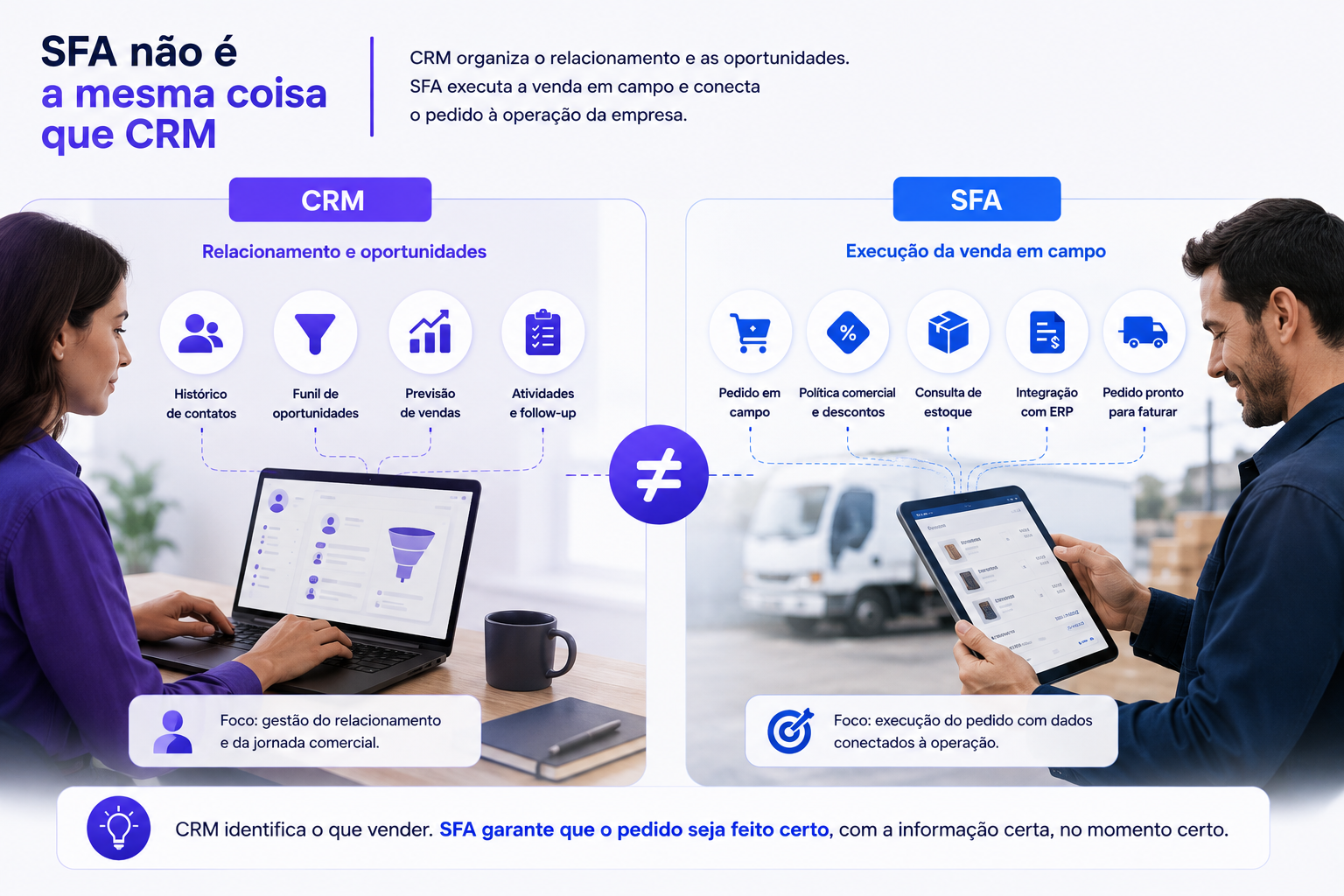
A company can have a robust CRM system and still lose an order due to an inventory error, because the CRM doesn’t sync with the ERP at the time of sale. That’s where SFA comes in. We’ll explore this difference in more detail in a separate article, because it changes the way you should evaluate suppliers.
Why SFA Became a Matter of Competitive Survival in 2026
Until recently, automating the sales force was viewed as an upgrade—a welcome improvement, but not an urgent one. That situation has changed.
By 2026, sales teams that adopt automation with contextual intelligence will close deals consistently faster than teams that still rely on manual processes. The difference no longer lies in whether or not a company “has technology.” It lies in how well that technology integrates with the rest of the operation.
By 2026, sales teams that adopt automation with contextual intelligence will close deals consistently faster than those that still rely on manual processes. The difference no longer lies in “whether or not they have technology,” but in how well that technology integrates with the rest of the operation.
Changes account for this turnaround:
Salespeople are no longer just order takers.
Distribution and manufacturing companies already manage the entire sales cycle within the SFA system: visit scheduling, inactive customer alerts, and performance dashboards by sales representative. The role of the salesperson has shifted from repetitive tasks to strategic decision-making, and this is only possible when the system supports that change.
Reliable forecasts have become a priority, not monthly reports.
Those who still operate manually aren't just slower. They're competing at a structural disadvantage that grows every quarter.
Signs that your operation still relies on manual processes
Some symptoms appear before the problem results in a visible loss in earnings. It’s worth checking to see if any of these are occurring in your operation:
- An order is entered twice—once in the field and once in the system—resulting in a discrepancy in the code or quantity;
- The representative is offering a discount that no longer exists, because the printed price list does not reflect the latest price adjustment;
- Management makes business decisions based on data from three or four days ago because the spreadsheet takes time to consolidate;
- A salesperson in an area with poor coverage loses the sale because they are unable to enter the order at the right time;
- The team treats the sales system as a monitoring tool rather than a work tool, and is reluctant to use it.
If two or more of these points sound familiar, your business is already paying an invisible cost. It doesn’t show up as a line item on the financial statement, but it affects your conversion rate, sales cycle time, and the turnover rate of sales representatives frustrated by rework.
What Changes When the Sales Force Works with a Well-Implemented SFA System
- Automation, when implemented properly, solves the problem at its root rather than masking it with more controls;
- The representative submits the order only once, with the correct sales policy applied automatically.;
- The back office receives an order that is ready to be invoiced, without any additional verification work;
- Management can view performance by sales representative, reason for refusal, and product with the highest return rate in real time—not just at the end of the month.
The direct result is time. Fewer hours spent typing means more hours available for trading. And in trading, time is revenue that hasn’t been captured yet.
For companies that already use SAP, there is an additional layer of complexity: ensuring that the sales policy in the sales system always matches the one configured in the ERP. We’ll address this specific issue in the next article in this series, because this is where most generic SFA implementations run into trouble.

Does your sales operation still rely on notebooks, spreadsheets, or outdated tables? CAST developed SalesCon to eliminate this rework at the source, with native integration with SAP. Talk to our team to learn how it works in practice.