


It’s closing day, and the spreadsheet freezes. Again. Someone entered the wrong formula in cell H47 three months ago, and no one noticed until now because the worksheet already has so many dependent cells that tracking down the error has become a project in itself. Meanwhile, a salesperson sends a message asking why his commission came in lower than expected. No one can answer right away. The response will take two days, three email exchanges, and a meeting.
This scenario plays out every month at thousands of companies. And the problem is rarely the spreadsheet itself. It’s what it failed to do.
Why does the spreadsheet stop working at some point?
Every company starts out simple: a fixed percentage of sales, one salesperson, one rule. A spreadsheet is enough to handle it. The problem arises when the business grows and the commission policy grows along with it.
Commission rules are piling up faster than the spreadsheet can handle
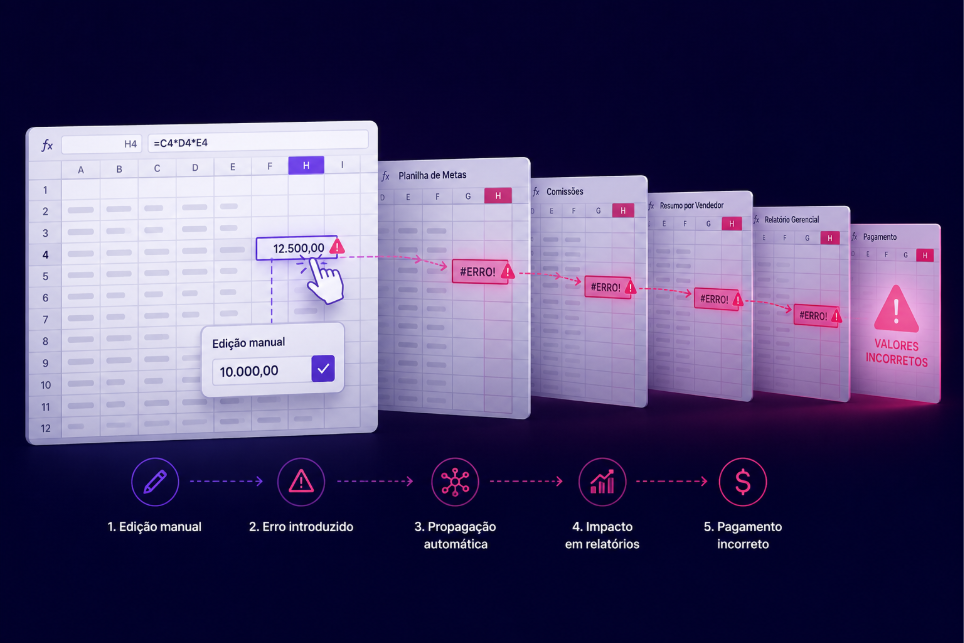
Targets by product. Accelerators by achievement tier. Exceptions for key accounts. Different commission rates for recurring and new sales. Each new rule is layered on top of the previous one, and industry research shows that most companies already operate with more than five active commission rules per plan, with nearly half managing more than ten payment variables in a single cycle. A spreadsheet wasn’t built for this. It was built for linear calculations, not for decision trees with dozens of branches.
The practical result: nested formulas that only one person in the company understands—and that stop working the day that person goes on vacation.
Every manual exception is a mistake waiting to happen
Every time someone has to manually adjust an amount—because the customer paid late, because the order was partially canceled, or because the rule for that month was different—the spreadsheet loses its traceability. There’s no log showing who changed what. There’s no automatic validation. Errors creep in unnoticed and only come to light when someone questions the amount received.
How much does this process cost, aside from the time it takes?

The most obvious cost is time. The most expensive is trust.
Commission disputes and friction with the sales team
Industry surveys indicate that most companies face commission disputes at least twice a quarter. Each dispute takes up the time of those who calculate commissions, those who manage the sales team, and those who need to verify the correct amount. And the side effect is worse than the time lost: a salesperson who doesn’t trust their own commission statement loses trust in the entire company. This affects engagement, retention, and, ultimately, how hard they work to meet their goals.
The time that should be spent on analysis becomes time spent on manual verification
Those who should be thinking about how to improve the commission policy spend the entire month checking numbers line by line. Entire teams from sales and finance spend days—sometimes weeks—just calculating commissions, time that could be spent understanding why one product sells better than another or why a region is underperforming.
Signs That Your Company Has Outgrown the Spreadsheet
There are some signs that the spreadsheet is no longer sufficient: 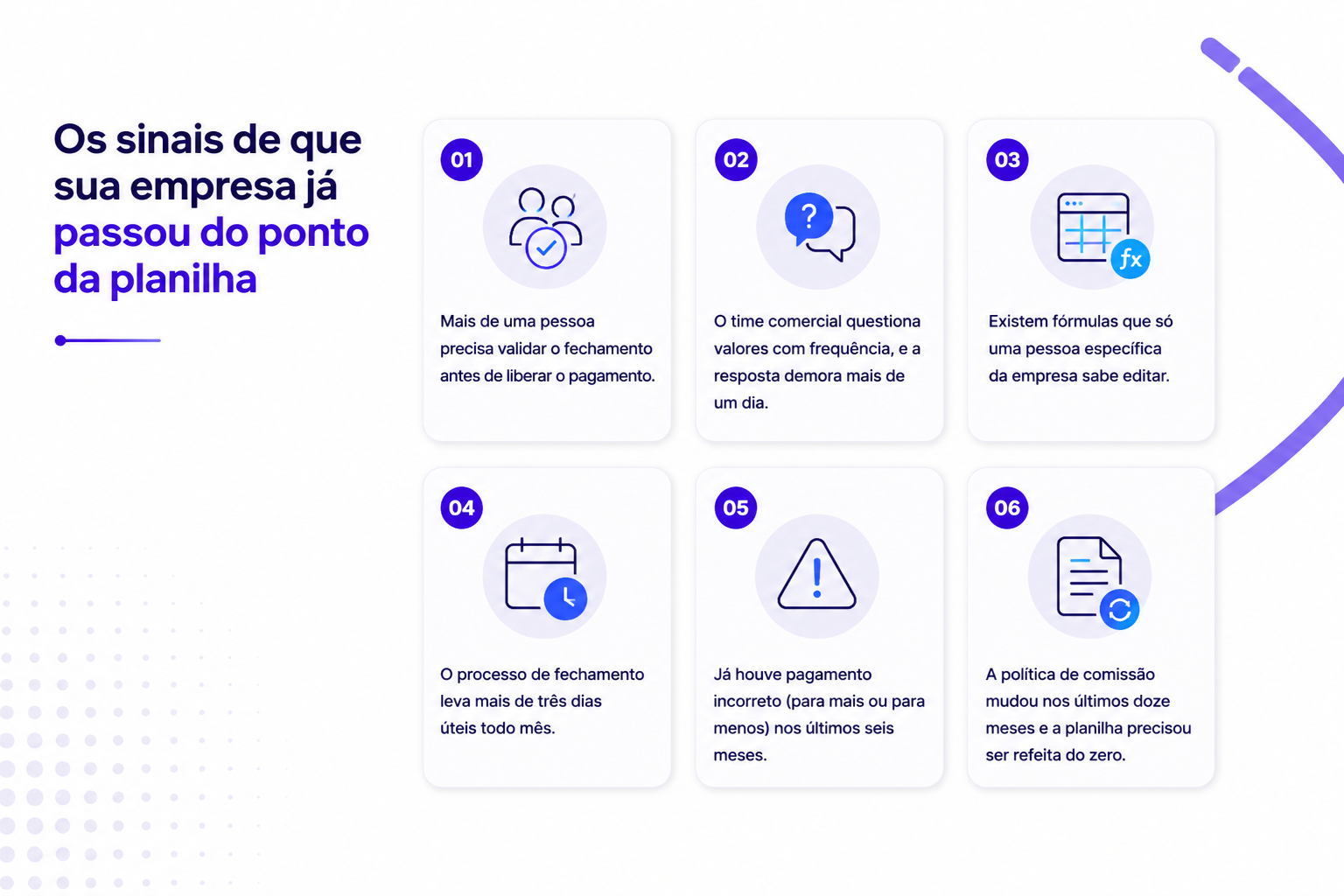
If you've identified three or more of these issues in your operation, the spreadsheet is already costing you more than it seems.
What changes when this process is automated?
Automating commission calculations isn't just about replacing one tool with another. It's about eliminating the manual step where errors occur.
Shorter downtime
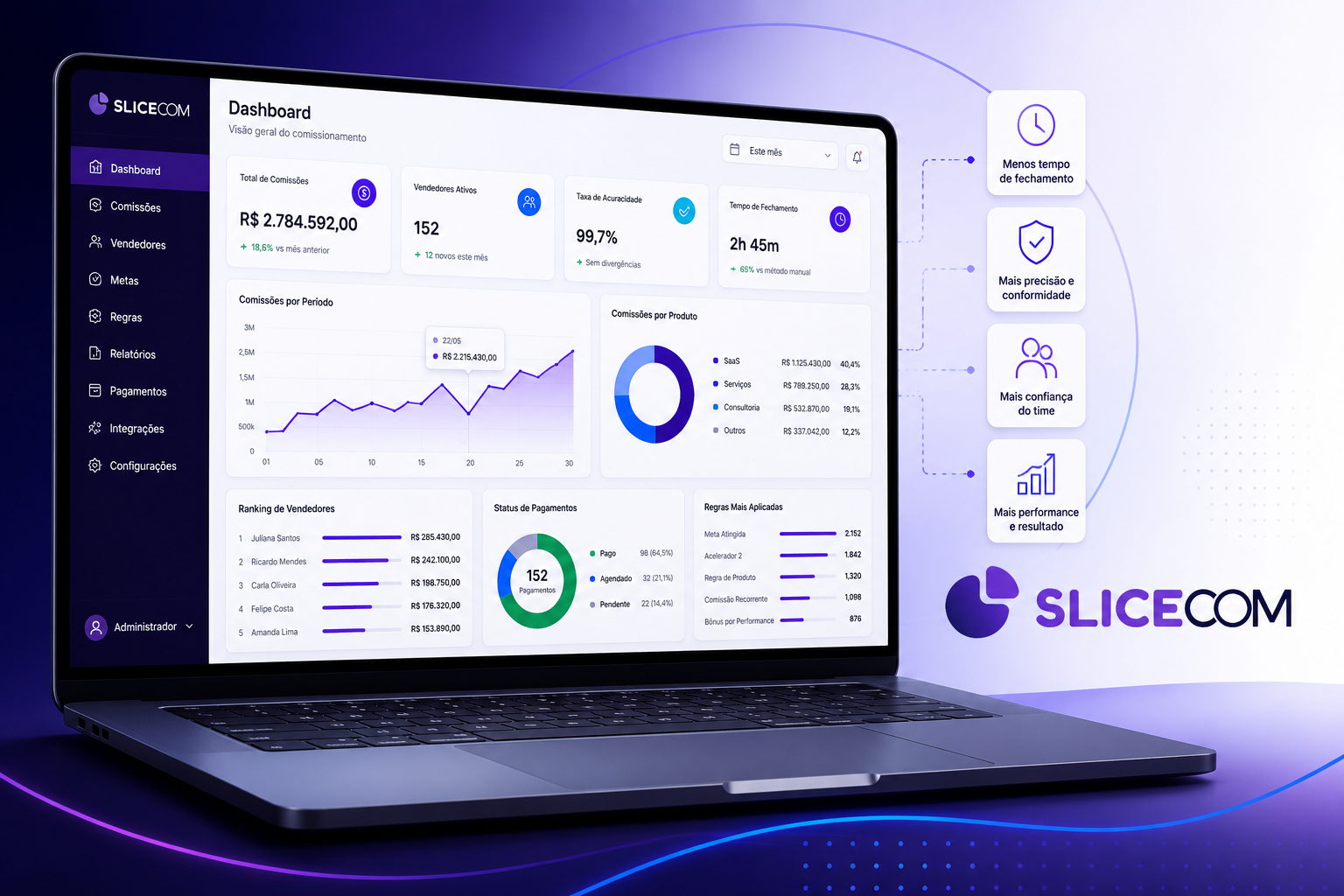
Companies that replace manual processing with a dedicated system report significant reductions in the administrative time required for calculations, with efficiency gains of up to 65% according to industry studies. This means closing out in hours, not days, and a team that is free to analyze results rather than search for formula errors.
Less conflict, more team confidence
When each salesperson can see how their commission was calculated—which sales were included, which rules were applied, and which targets were met—competition subsides. The same survey shows a drop of up to 40% in commission disputes following automation. It’s not just an operational gain. It’s the sales team regaining trust in the process that determines their own pay.
This type of solution already exists and is more accessible than most companies realize. Not as a full-fledged ERP system, but as a specialized layer that integrates with what the company already uses, without forcing a system change. It’s worth exploring the options before accepting that spreadsheets are the limit of what can be done.
Want to see how commission management works when it's no longer handled in a spreadsheet? Discover SLICECOM.
Would you prefer to speak directly with an expert? Contact CAST.